2601-A Wilson Boulevard Arlington, VA 22201

Advanced Imaging for Accurate Diagnosis
At Caring Hands Animal Hospital, advanced imaging helps our veterinary team diagnose and treat pets with greater clarity. Our diagnostic capabilities include digital radiology, ultrasound, and endoscopy. These tools allow us to assess bones, soft tissues, internal organs, and certain areas of the body that may not be fully evaluated through a physical exam alone.
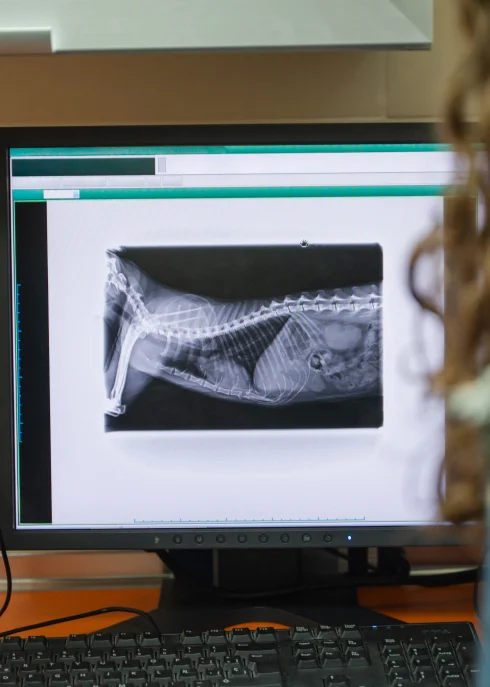
X-rays (radiology) are another important tool that helps examine soft tissues, internal organs, and bones. Often, both digital X-rays and ultrasound are recommended together for a more thorough evaluation.
Digital X-rays show the size, shape, and position of organs, while ultrasound provides a detailed look at their internal structure. This non-invasive procedure is safe and well-tolerated by most pets.
By combining these advanced imaging techniques, we can quickly and accurately diagnose medical conditions, ensuring your pet gets the best possible care.
As our services continue to grow, we also plan to offer CT imaging to provide even more detailed diagnostic options for pets in Clarendon, VA.
Advanced Imaging and Diagnostic Care
We provide a variety of diagnostic services to thoroughly evaluate your pet’s health. With advanced imaging tools like ultrasound, endoscopy, CT Imaging, we can quickly detect medical conditions and start the right treatment without delay.
Ultrasound
Ultrasound, also called a sonogram, uses sound waves to create images of your pet’s internal organs. These images appear on a monitor, giving the veterinarian a clear, two-dimensional view of important organs like the heart, liver, gall bladder, spleen, kidneys, pancreas, and bladder.
Often, both digital X-rays and ultrasound are recommended for a complete evaluation. While X-rays show the size, shape, and position of organs, ultrasound provides a detailed look at their internal structures. This procedure is safe, non-invasive, and well-tolerated by most pets.
To ensure clear imaging, the fur on your pet’s abdomen may need to be shaved. A special gel is then applied, and the ultrasound probe is gently moved over the area to capture detailed images. Since ultrasound provides real-time results, veterinarians can often assess the findings immediately. In some cases, images may be sent to a veterinary radiologist for further analysis, which could take a few days.
Most ultrasound exams do not require anesthesia, as the procedure is painless. Pets usually remain calm and lie comfortably on a soft blanket. However, for pets that are very anxious or restless, mild sedation may be needed.
Ultrasound is an invaluable tool for diagnosing pregnancies, evaluating internal organs, and assessing heart function—helping to ensure your fur baby gets the best possible care.
Endoscopy
Endoscopy is an advanced diagnostic procedure that uses a small camera on a flexible tube to examine certain internal areas of your pet’s body. It can help veterinarians evaluate the digestive tract or airways without making a large surgical incision.
Endoscopy may help with:
- Evaluating ongoing vomiting, regurgitation, or swallowing concerns
- Examining the digestive tract or airways with a small camera
- Looking for certain swallowed objects or areas of irritation
- Collecting tissue samples for further evaluation
- Removing select foreign objects without a large surgical incision
- Supporting a more focused diagnosis and treatment plan
The veterinarian will explain whether endoscopy is appropriate for your pet and discuss any needed preparation, anesthesia, and aftercare.
CT Imaging
CT imaging, also known as computed tomography, creates detailed cross-sectional images of your pet’s body. It gives our veterinary team a closer look at complex areas, including bones, joints, nasal passages, the chest, and internal structures.
This advanced technology supports more thorough diagnostic evaluations and treatment planning when standard X-rays or ultrasound do not provide enough detail. CT imaging can help guide care for injuries, persistent health concerns, and complex medical conditions.